Showing posts with label 3D Construction. Show all posts

Wednesday, 9 May 2012

Working on to a mannequin

Following my work with prints via photocopying and hand-drawings, I thought it would be good to see how the pieces looked on a mannequin, as improvised garments, or parts of garments, to possibly use in our final piece. 


I enjoyed doing this task, it's good to see how this piece looks a a dress, gathered, pleated and draped. As a group we have often talked about perhaps using draping fabrics as background, or parts of a garment, so I did a piece to portray a sleeve draping down:


I am happy with this piece even more so now, and look forward to carrying out more, similar samples.

Sunday, 19 February 2012

Sampling unit:
Ordered Opposites: Rural/Urban: Hard/Soft
Evaluation of Project 2:

In past projects, I have found a weakness in not carrying out appropriate and on-going research. In this project I feel I have embraced my own challenge of conducting thorough research using myriad techniques and materials. I have made relevant connections between my research and practice, for example:

I took this photograph of a building in Spinningfields, Manchester and looked solely at the structure of the building:

After investigating the structure of the building in my sketchbook, I created this piece of development to begin thinking of how I could use my materials to re-create the forms.


I am happy with this as my first 3D Construction sample, as I felt I carried out good research, development of ideas and then the final idea, using quite literal thinking, to create a hard & soft themed garment.

I always make sure I use context in my work, to give my samples a meaning beyond aesthetics. A good example of this is my “Filing Cabinet” piece. On my walk through Manchester, in which I set out to find form and structure in the city, I discovered the “Filing Cabinet” building:

This image inspired me straight away with the shapes and I started thinking of different ways to present my ideas:


I wanted to come up with a more lateral design compared to my last sample, so played with my ideas, leading to this garment design:


In an effort to maintain my Hard & Soft theme, I created the body of the garment to have a soft, sleek bottom seam, to contrast the square shapes. This leads to my next design, and quite an important self- discovery- my mark making techniques. During tutorials my tutor has pointed out that my work is very similar to that of a print students, a workshop I didn’t think to do as I thought I was a more constructive designer. However, in our Drawing Day task, we created our own brushes and mark makers. I used visual images from my sketchbook and experimented using my mark makers, oil paints, acrylic paints and charcoal. This task really inspired me and lead to me developing my marks in to 3D samples. Here is one example:

I took this photo during a walk through Blanchland in Northumberland during the Christmas Holidays, using this image, I created this mark making during the workshop:

I then went on to create a 3D sample using the "Filing Cabinet" idea:


I feel that this work further proves my lateral thinking ability, as I have taken a visual source and developed it in a non-conventional way. This is also my risk-taking piece, because instead of creating a sample using calico and chicken wire to enable structure, I used advice from tutorials, as well as advice from the Drawing Day, and created my own print, to apply to my development from “The Filing Cabinet” piece.

Throughout this project, I believe I have used my time efficiently. During the knit workshop I was still a little weary about making connections between my research and practice, because I carried out a lot of visual and contextual research over weekends and the christmas holidays, so I found it difficult to narrow down ideas.


Although I created plenty of samples with developed colour themes, I didn’t feel any of them were very final to the point of being able to imagine them as a garment, however enjoyed making the sample boards- which could eventually lead to more developed samples if I went back to them.

This allowed me to do my research a little differently in the 2nd part of the project, because I was doing 3D Construction I knew that I should just begin my looking at form and structure. I believe the last month of the project went quite well, as I had planned to create 2 or 3 quality samples, with well developed connections between my research, my hard & soft theme, my materials, workshops and practice.

Thursday, 17 November 2011

Origins Unit 1:
DRAWING TASK 2:

Initial feelings about my sketchbook:
Before I started my sketchbook and research I definitely had blank-page fear! I wasn’t even sure how to begin research until our introductory 3D Construction Workshop. Even after research I wasn’t entirely sure what I wanted to include but eventually I just jumped in to it and am happy with how it begins. I looked forward to the sketchbook exhibition because I wanted feedback from others about my content and how well it answers the brief. I found the overall feedback from the session helpful and will include more drawings and annotation to make the work a little more coherent.

VISUAL:
The drawings in my sketchbook are inspired by the photographs I took of Canal Street on the first week of the project. I tried to find certain shapes and textures to draw from, which I believe I did successfully, in order to find things to inspire my 3D Construction work, and eventually my Digital Image Making work.

I feel this page is a good example of layout, drawing styles and variety of ideas. I took the photograph on the left and drew a line drawing of the chairs, however I feel my drawing ability lets me down when I do line drawing so I did a blind drawing. I thought that the second drawing was more successful as it provides more abstract visuals. Through out my sketchbook I have included a variety of line, tonal, blind and negative drawings, which have helped me with my work, however I feel I could have done more of them.

CONTEXTUAL:
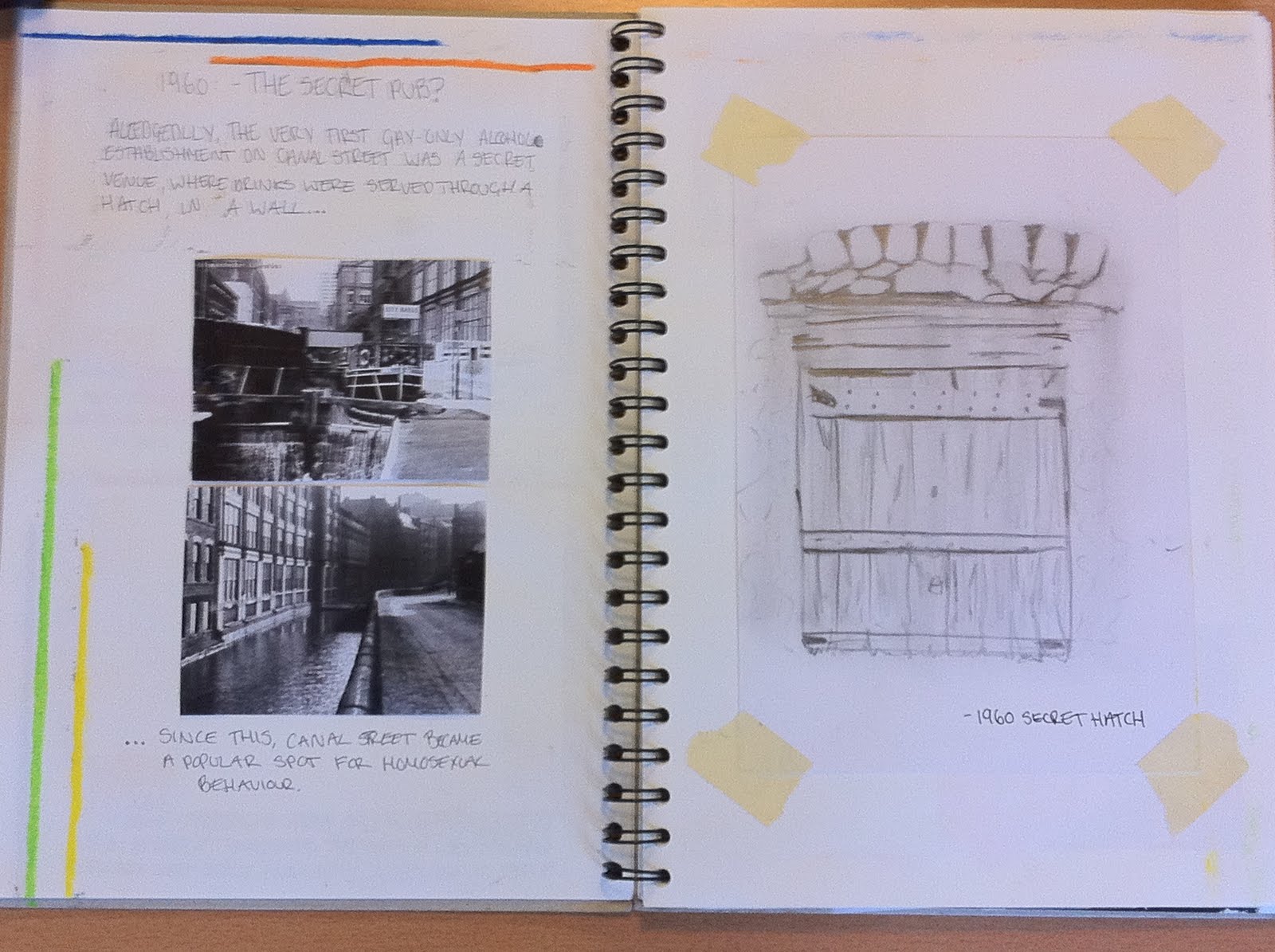
My research began with taking photos of Canal Street to then draw from. However I also looked at the history of the area too, for example Alan Turing and the Secret Hatch. I also came up with keywords after researching the history:

I thought this was a good idea as it helps to conclude everything I had learnt about the history of area. My 3D construction designs are benefitted with shapes, textures and concepts driven from all of my visual and historical research. I haven't included artist research in my sketchbook, as I focused more on my research and drawings in the beginning. I think in terms of relevant design awareness in relation to my research I have done well, however I understand after the Sketchbook Exhibition that I should add annotation to make it clearer how I came up with the designs.

CONTENT:
I think my sketchbook so far flows quite well. I have included historical research and visual research, integrated with my own drawings and designs (once annotated is included it will be clearer). I think a good example of this is my investigation in to the 1960 Secret Hatch.
Although I was basing the idea on a rumoured Secret pub, I used internet imagery, my own interpretation of the wooden hatch, and went on to create garment ideas in 3D construction workshops:

Wednesday, 2 November 2011

Origins Unit 1:
SLEUTHS, SPIES AND LIES:
Initial Research:
I have chosen Canal Street for my project because I feel there are so many things I could look at in the theme of “Sleuths, Spies and Lies”, including the history of the area and the present imagery (i.e colours, shapes and textures)
My first step of research was to go out and take photographs of the area, focusing on the bar paraphenalia. I then looked in to the history of the area, to understand how Canal Street became a popular homosexual bar area.


My favourite part of researching was finding out about the “Secret Pub” which was allegedly the first homosexual- only pub, where drinks were served through a hatch in the wall to preserve peoples privacy at a time when homosexuality was illegal.


I also researched a man called Alan Turing who committed suicide after being arrested for his sexuality. To conclude my historical research of the area I came up with keywords which describe the area through time.


Workshop Series 1:
I chose to do the 3D Construction workshop. With an interest in fashion designing and making I knew I would enjoy it and be able to make the most out of it with my prior knowledge.
In my first couple of weeks of 3D Construction Workshops I used the photographs I took of canal street to create 3D samples straight on to the mannequin:


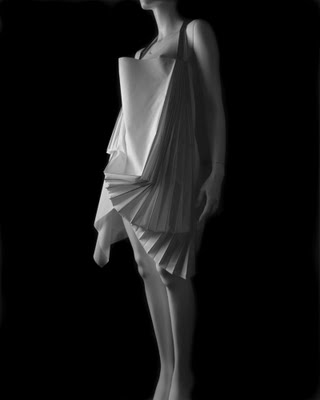
I thought working with pleats was a good technique and reflected the repetition of homophobia on Canal Street. Over the course of the 3D construction workshops I looked at designers who also use pleats in there work, including Issey Miyake, although I have used pleats in a more uniformed, wearable way, I admire Miyakes innovative way he can create pleats in different ways. Miyake uses pleats in a constructive, avant garde way (picture #1), but also demonstrates the technique in a more fluid way (picture #2).

#1

#2


After playing around with samples and creating visual imagery based on photographs and drawings, I decided to follow this with creating some actual garments. I kept them simple, but wearable. And based them upon a blind drawing I did of a photograph of stacked chairs on Canal Street: